AI, Digital IDs, and the Control Infrastructure the Book of Revelation Described
A system capable of controlling all buying and selling is being constructed in real time — by governments, central banks, and technology companies who have never read a word of Revelation 13. Here is what the text actually says, what is actually being built, and what we can and cannot claim.
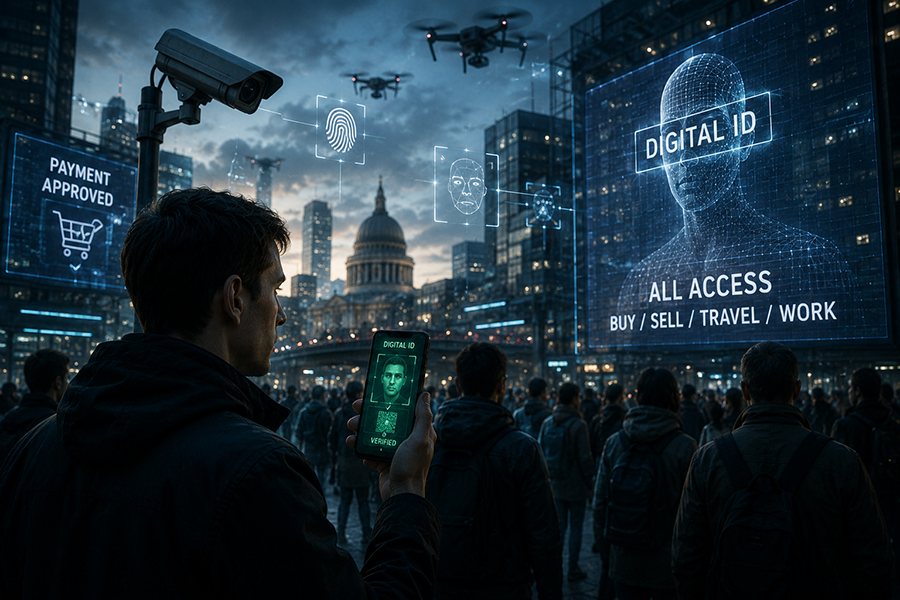
The infrastructure of control described in Revelation 13 is not a distant abstraction — it is being engineered now, by people who have no idea they are building it.
In February 2022, the Canadian government invoked the Emergencies Act and instructed financial institutions to freeze the bank accounts of anyone connected to a protest movement that had occupied the capital for three weeks. Within 48 hours, accounts were frozen — without court order, without criminal charge, without due process — simply because a database matched a name to a cause the government had decided to oppose. People could not buy groceries. They could not fill their gas tanks. The money was still in the account. They simply could not access it.
That was not China. That was not Russia. That was Canada — one of the most stable, democratic nations on earth. And most people who watched it happen did not know what to call it. But anyone who has read Revelation 13 felt something familiar stir.
This article will not tell you that what happened in Ottawa was the fulfillment of Revelation 13. It wasn’t. But it will walk you through what John actually wrote, what is actually being built by governments and central banks right now, and why the architecture described in a vision given to a prisoner on a Greek island two thousand years ago has never looked more recognizable than it does today.
What Revelation 13 Actually Says
John’s vision of the second beast — the one who enforces the authority of the first — ends with a specific, chilling economic mechanism. It is worth reading slowly.
“Also it causes all, both small and great, both rich and poor, both free and slave, to be marked on the right hand or the forehead, so that no one can buy or sell unless he has the mark, that is, the name of the beast or the number of its name.”
Notice what the text is describing. This is not primarily a theological symbol. It is an economic control system. The mark is the mechanism of access — without it, you cannot participate in commerce. You cannot buy food, pay rent, access your wages, or conduct any financial transaction. Compliance with the system is enforced not by soldiers at every door but by the payment infrastructure itself.
John wrote this in an era of coins, barter, and local markets. The idea of a global system that could monitor and gatekeep every financial transaction would have been, in any prior century, an obvious impossibility. It is no longer impossible. It is being built.
The Infrastructure Being Assembled Right Now
You do not need prophecy to see what is being built. The architects are publishing white papers, holding press conferences, and passing legislation. They call it financial modernization. They call it security. They call it inclusion. Here is what it actually consists of:
Taken separately, each of these can be explained as a convenience, a security measure, or a financial innovation. Taken together, they form the precise architecture that Revelation 13 describes: a single, integrated system through which all buying and selling can be permitted or denied based on compliance with a central authority.
What We Can — and Cannot — Claim
This is where the discipline matters. Prophecy teachers have a long record of matching the current technology to the imminent fulfillment, only to be proven wrong within the decade. We should be honest about what we know and what we don’t.
CBDCs are not the mark of the beast. The mark in Revelation 13 is tied to a specific person — the beast — and to a specific act of worship and allegiance. We have not seen that person. We are not in that moment.
Digital ID is not the mark. The EU eID wallet, India’s Aadhaar system, and even China’s social credit system are not fulfillments of the text. They are preconditions — the kind of infrastructure that would make such a system possible at global scale.
We cannot name the year. Jesus said no one knows the day or the hour (Matthew 24:36). That includes the generation. We watch. We do not predict.
What we can say is this: for nineteen centuries, every reader of Revelation 13 had to imagine — as a matter of pure faith — how a single system could monitor and control all commercial activity for every person on earth simultaneously. That required imagination. It no longer requires imagination. It requires only a software update.
The Pattern Scripture Already Showed Us
Revelation 13 is not the first time Scripture described a ruler who demanded economic and political compliance on pain of exclusion. The pattern runs through the whole canon.
Nebuchadnezzar’s golden image (Daniel 3). A ninety-foot statue. A command to bow. Musicians on cue. And a furnace for those who refused. The mechanism was different — fire, not financial exclusion — but the logic was identical: worship the system or lose everything. Shadrach, Meshach, and Abednego answered with seven of the most important words in Scripture: “But if not, we will not serve your gods.”
Domitian’s Rome. When John wrote Revelation, the emperor demanded worship at imperial cult temples as a condition of participating in the trade guilds. No worship — no guild membership. No guild membership — no livelihood. Every craftsman, merchant, and tradesperson in Asia Minor knew exactly what John meant when he wrote about not being able to buy or sell. They were living a version of it.
The pattern is this: every empire eventually demands what belongs only to God — allegiance, worship, identity. And every empire, eventually, falls. John’s vision does not end with the beast triumphant. It ends with a city coming down from heaven, and a voice crying: “Behold, the dwelling place of God is with man.”
“And the beast was captured, and with it the false prophet who in its presence had done the signs by which he deceived those who had received the mark of the beast and those who worshiped its image. These two were thrown alive into the lake of fire.”
How to Live in This Moment
The question is not whether the infrastructure is being built. It is. The question is how we live now — before the final form of that system arrives, in a world where its pieces are already visible.
Peter asked it plainly: “Since all these things are thus to be dissolved, what sort of people ought you to be in lives of holiness and godliness?” (2 Peter 3:11). The information is not the goal. The transformation is.
First: do not be afraid of the technology. Fear is not the posture Scripture calls us to. “God gave us a spirit not of fear but of power and love and self-control” (2 Timothy 1:7). Use your phone. Use digital payments. These tools are not the mark. The mark is a specific, final act of allegiance to a specific person — and when that moment comes, every genuine believer will recognize it.
Second: hold your earthly security loosely. The Canadian trucker example is instructive not because it was Revelation 13, but because it revealed how quickly financial access can become a lever. Christians who have placed their security in their savings, their investments, or their government’s goodwill are building on sand that is shifting. The ancient posture of the church was not financial insulation but radical dependence: “I have learned, in whatever state I am, to be content” (Philippians 4:11).
Third: stay rooted in community. The early church survived empire not by withdrawing from the world but by being so thoroughly bound to one another that no external system could isolate them. They shared what they had (Acts 2:44). They met in homes. They prayed together. When the system comes, isolation will be the weapon — and community will be the answer.
“Do not fear what you are about to suffer… Be faithful unto death, and I will give you the crown of life.”
The infrastructure is real. The trajectory is clear. And the God who wrote the end of the story before the first line of history was drafted has not changed his mind about how it ends. Watch. Stay ready. Do not be afraid. The beast loses. The Lamb wins. Every technology being assembled right now is, without knowing it, setting the stage for the most decisive moment in human history — and the wrong side is building the props.
Don’t miss the next article in this series.
New Prophecy Watch articles, sermons, and devotionals delivered free every week. No cost. No spam. Just Scripture and truth.
Subscribe Free →