Ezekiel’s Coalition Is Forming — Here Are the Exact Nations He Named 2,600 Years Ago
In Ezekiel 38, a prophet exiled in Babylon listed the nations that would one day move against Israel. This spring, missiles, intelligence, and intercepted satellites moved across the very map he drew. Here is what the text actually says — and what it does not.
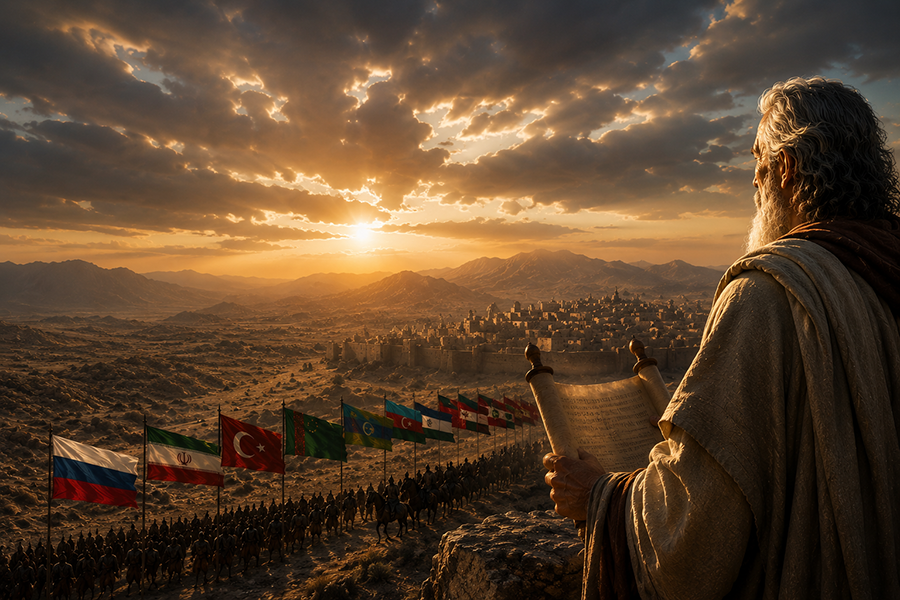
The ancient world Ezekiel wrote in — and the modern one his words describe with precision.
In the spring of 2026, missiles fired from Iranian soil crossed into Turkish airspace and were intercepted by NATO defenses near Incirlik. Russian satellites quietly fed Iran targeting data on American bases. The Strait of Hormuz was blocked, and the global economy felt it within days. For ten weeks, the United States and Israel were formally at war with Iran and its regional allies.
If you read the news that spring and felt a strange, unshakable sense that you had read something like this before — somewhere ancient, somewhere far older than CNN or Reuters — you were not imagining it. It is in your Bible, in a book most Christians skim past on their way to Daniel and Revelation: the book of Ezekiel.
Twenty-six centuries ago, a priest-turned-prophet sat among Jewish exiles on the banks of a Babylonian canal and wrote down a vision. The Lord named specific nations — not symbols, not generic “the nations,” but named peoples and rulers — who would one day come against Israel in a coordinated, multinational assault.
This article will not tell you the war we just watched was Ezekiel 38. It wasn’t, and we’ll explain why. But it will walk you through what Ezekiel actually said, who he actually named, and how directly those names map onto nations making headlines this very year.
What Ezekiel Actually Wrote
Open your Bible to Ezekiel 38. The Lord tells the prophet to “set your face toward Gog, of the land of Magog, the chief prince of Meshech and Tubal” (38:2). This is the language of a court summons, not a poem. The text continues by listing his allies — Persia, Cush, Put, Gomer, and Beth-togarmah (38:5-6).
This coalition comes “from the uttermost parts of the north” (38:15) with a stated war aim: to seize spoil and plunder a people who dwell securely (38:11-12). This is not abstract judgment language. This is an army with a target.
What Happens Next — And Why It Matters
Here is where careful reading must do its work. What follows in chapters 38-39 is not a description of ongoing geopolitical friction. It is a divine intervention that ends the invasion supernaturally.
“I will rain upon him and his hordes and the many peoples who are with him torrential rains and hailstones, fire and sulfur… so they shall know that I am the Lord.”
God himself destroys this coalition — not Israel’s army, not American intervention, not a negotiated ceasefire. The purpose stated in the text is the vindication of God’s holiness, “in the midst of my people Israel” (39:7). We have not yet seen that.
So What Did We Actually Watch Happen?
This is where this article wants to be honest rather than tidy. When the 2026 war broke out, some of Ezekiel’s named parties did move into position — Russia gave Iran intelligence support, and Iran (explicitly “Persia” in the text) was the central combatant.
Turkey did not join this coalition. Ankara mediated between Washington and Tehran, hosted NATO Patriot batteries to intercept Iranian missiles, and declined to participate in any campaign against Israel.
Russia avoided military commitment. Putin condemned the strikes rhetorically but offered no troops — reportedly because he could not afford to lose a direct fight with the United States or damage ties with Israel and the Gulf states.
It would be easy — and dishonest — to take a headline reading “Russia aids Iran” and declare Ezekiel 38 is unfolding before our eyes. The actual picture is messier. That messiness does not disprove anything. It simply means we are not there yet — and we should say so.
What we can say, without overreaching: the precise nations Ezekiel named are not scattered randomly across irrelevant ancient history. They are, right now, among the most consequential players in the geopolitics surrounding Israel. That is not nothing. It means the geography God spoke of has not gone silent.
A Word on Discipline Here
Prophecy teachers have a long, embarrassing history of matching today’s headline to tomorrow’s rapture, only to be proven wrong within the year. Jesus himself, asked directly about timing, said:
This is not a contradiction of watchfulness — Jesus commands watchfulness in this very discourse (24:42-44). It is a warning against claiming knowledge God has not given. We can say with confidence: the nations of Ezekiel 38 are clustered around Israel today in a way no other era has matched. We cannot say: this is the year, the war, the generation.
One Story, Told by Many Voices
This pattern — nations gathering against God’s people, met by divine judgment — echoes across the whole canon. The Psalmist saw it (Psalm 2:1-2). Daniel was shown kingdoms rising until “the God of heaven will set up a kingdom that shall never be destroyed” (2:44). Zechariah pictured all the nations gathered against Jerusalem before the Lord comes to fight for his people (14:2-4). John, on Patmos, was shown its final form at Armageddon (Revelation 16:16), a war only Christ ends by his return (19:11-16).
One God. Many men. More than a thousand years. One story: the nations will gather, God’s name will be vindicated, his King will reign.
Living Ready, Not Afraid
Peter asked the only question that matters: “Since all these things are thus to be dissolved, what sort of people ought you to be in lives of holiness and godliness?” (2 Peter 3:11). The information is not the goal. The transformation is.
“And now, little children, abide in him, so that when he appears we may have confidence and not shrink from him in shame at his coming.”
The nations named in Ezekiel 38 have not disappeared from the map. We do not know the day. We do know the God who wrote the names down — and what he asks while we wait: not fear, but faithfulness; not speculation, but readiness — “waiting for our blessed hope, the appearing of the glory of our great God and Savior Jesus Christ” (Titus 2:13).
Don’t miss the next article in this series.
New Prophecy Watch articles, sermons, and devotionals delivered free every week. No cost. No spam. Just Scripture and truth.
Subscribe Free →