Damascus and Isaiah 17: The Most Ignored Prophecy About to Be Front-Page News
Isaiah wrote that Damascus would become “a heap of ruins” — and then cease to be a city entirely. It has never happened. Damascus is the oldest continuously inhabited city on earth. Which means the prophecy is still waiting. And recent events suggest the waiting may be ending.
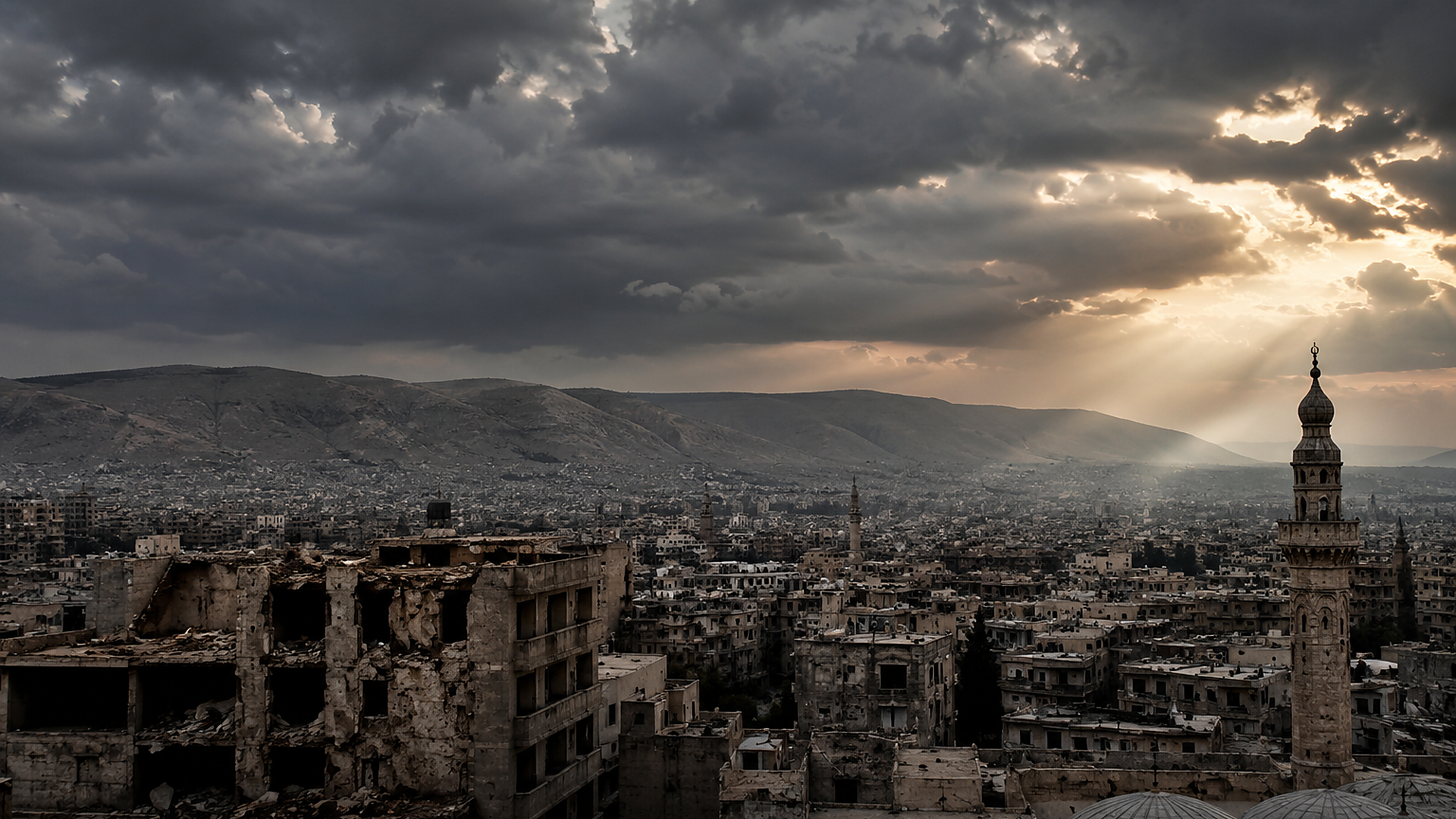
The ancient world Isaiah wrote about and the modern one his words describe have never been closer than they are right now.
On the night of December 7, 2024, Bashar al-Assad boarded a plane and fled Damascus. The man who had survived chemical weapon accusations, international sanctions, American airstrikes, Russian intervention, and fourteen years of civil war — a man whose family had ruled Syria with an iron grip for fifty-three years — left in the dark, without announcement, without ceremony, without even informing his own generals. By morning, rebel fighters were walking through the presidential palace. The guards were gone. The furniture was still there.
Damascus — the oldest continuously inhabited city in human history, a city that has survived the Assyrians, the Babylonians, the Persians, Alexander the Great, the Romans, the Byzantines, the Arab conquest, the Crusades, the Mongols, the Ottomans, and the French — had fallen in eleven days.
Most of the Western world processed this as a geopolitical event. A dictator fell. Rebels won. Complicated regional power dynamics would follow. File it under Middle East instability and move on.
But anyone who has read Isaiah 17 did not move on.
What Isaiah Actually Wrote
The seventeenth chapter of Isaiah opens with eight of the most quietly explosive words in prophetic literature. They were written approximately 2,700 years ago — during the reign of Ahaz, king of Judah, when Damascus was the capital of the powerful Aramean kingdom and a geopolitical force that Israel had reason to fear.
“An oracle concerning Damascus. Behold, Damascus will cease to be a city and will become a heap of ruins. Her cities are deserted forever; they will be for flocks, which will lie down, and none will make them afraid.”
“The fortress will disappear from Ephraim, and the kingdom from Damascus; and the remnant of Syria will be like the glory of the children of Israel, declares the Lord of hosts.”
The language is absolute. Not Damascus will be weakened. Not Damascus will be conquered and rebuilt. Damascus will cease to be a city. It will become a heap of ruins — meiy medammah in Hebrew, a pile of rubble — a place where flocks graze, where no one lives, where the city itself simply no longer exists as a functioning human settlement.
This has never happened. In the entire 2,700-year history since those words were written, Damascus has never been destroyed. It has been conquered, occupied, damaged, and fought over. But it has never ceased to be a city. It is today a metropolitan area of roughly 2.5 million people. Which means the prophecy is not yet fulfilled — and is still waiting.
Why This Is Remarkable
Isaiah’s prophecy against Damascus stands in sharp contrast to his other geopolitical prophecies, most of which have been fulfilled with stunning precision. The fall of Babylon (Isaiah 13–14) — fulfilled by Cyrus in 539 BC. The judgment on Moab (Isaiah 15–16) — fulfilled. The judgment on Egypt (Isaiah 19) — fulfilled in multiple waves. Tyre (Isaiah 23) — fulfilled by Nebuchadnezzar and then Alexander the Great so completely that the ancient city literally became a bare rock used for spreading fishing nets, exactly as Ezekiel predicted.
City after city that Isaiah named has been reduced to ruins or disappeared entirely from the geopolitical map. Damascus alone stands — not merely surviving, but thriving enough to be the capital of a modern nation-state with international diplomatic recognition, an airport, universities, and restaurants.
What December 2024 Changed
The fall of Assad did not fulfill Isaiah 17. Let that be said clearly. Damascus stands. But what the events of December 2024 did was reveal something important about the city’s vulnerability that had not been visible before.
What December 2024 produced was the most unstable Damascus has been in modern history — a city at the center of a power vacuum, surrounded by armed factions, with no functioning state, a devastated military infrastructure, and a regional war between Israel and Iran’s proxy network playing out in the surrounding territory.
For the first time in the modern era, the conditions under which Isaiah 17:1 could be fulfilled are not unimaginable. They are visible on a map.
What We Can and Cannot Claim
Assad’s fall is not the fulfillment of Isaiah 17. Damascus is still a city. The prophecy requires it to cease to be a city — permanently. That has not happened.
We do not know when or how it will happen. The mechanism Isaiah describes is not specified in the text beyond the outcome itself. Whether it comes through military strike, natural disaster, or some other means — Isaiah does not say, and we should not speculate beyond the text.
We cannot set a date. Christians have been matching current events to end-times prophecy for two thousand years, and the record of specific predictions is uniformly embarrassing. We watch. We note. We do not predict.
What we can say: Isaiah 17 is an unfulfilled prophecy about a real city that exists today in conditions of unprecedented instability. The text is not symbolic. The city is not a metaphor. And the God who fulfilled every other prophecy in this chapter has not retracted this one.
The Pattern: God Names Cities and Cities Fall
Isaiah 17 is not an isolated curiosity. It belongs to a category of prophecy that runs through the entire Old Testament — specific, named geopolitical predictions about real cities and nations, stated in plain language, fulfilled with documented historical precision.
Nineveh — Nahum said it would be destroyed and “become a desolation” (Nahum 3:7). Nineveh fell to the Babylonians and Medes in 612 BC and was so completely destroyed that its location was unknown for centuries. Archaeologists rediscovered it in the 1840s.
Tyre — Ezekiel said Nebuchadnezzar would destroy it, that its stones and timber would be “thrown into the sea,” and that it would become “a bare rock” used for “spreading nets” (Ezekiel 26:4–5, 12). Alexander the Great completed the fulfillment in 332 BC by using the rubble of mainland Tyre to build a causeway to the island city. That causeway still exists. The fishing nets still spread there.
Babylon — Isaiah said it would be like Sodom and Gomorrah, “never inhabited” (Isaiah 13:19–20). Babylon today is an archaeological site south of Baghdad. It has not been continuously inhabited since its fall.
In each case, the prophecy seemed impossible when it was written. In each case, it was fulfilled — often by means no one anticipated, on a timeline no one predicted. Damascus is the remaining name on the list that no one has crossed off yet.
Why This Should Make Us Pay Attention
There is a temptation, when reading prophecy, to treat it as a puzzle to be solved — a code to be cracked, a date to be calculated, a map to be drawn. That is not what Scripture asks of us. What it asks is something simpler and harder: watchfulness without anxiety, awareness without obsession.
Isaiah 17 is not primarily a warning about Damascus. It is a declaration about God. It is God saying — through his prophet, to his people, across twenty-seven centuries — I see this city. I know its name. I know its end. I am not surprised by what you are watching on the news. I wrote the end of this story before the first chapter began.
“I am God, and there is no other; I am God, and there is none like me, declaring the end from the beginning and from ancient times things not yet done, saying, ‘My counsel shall stand, and I will accomplish all my purpose.'”
This is the God who named Damascus in the eighth century BC and whose word about it has not returned void — it has simply not yet been fulfilled. Every year Damascus still stands, his patience is on display. Every year it stands, his precision is being reserved for the moment he has appointed.
The Christian’s response to this is not fear, not date-setting, not obsessive watching of Syrian news feeds. It is the response Jesus called for in every prophetic discourse he ever gave: be ready, stay faithful, love your neighbor, hold your life loosely. Because the God who keeps his word about cities keeps his word about everything — including the promises he made to his people about what is coming on the other side of all of this.
Damascus will one day cease to be a city. That is not a political opinion. It is a word from the Lord. And the God who said it has never been wrong about anything yet.
Don’t miss the next article in this series.
New Prophecy Watch articles, sermons, and devotionals delivered free every week. No cost. No spam. Just Scripture and truth.
Subscribe Free →